Sixty Lines and a Hinge
My terminal is a phone now. Choosing which one was the hard part.
This one is not about models, agents or harnesses, or how to optimise your workflow. Some of what I have been working with I cannot write about, and by the time I could, it would be old news here.
It has also been six weeks since the last post. So this is about the other thing that changed in that time: my terminal is now a phone.
// what was left to type
The terminal on my desk is 288 columns wide. It was set up by someone who expected to spend his days reading code, and for a long time he did.
It is not most of the work any more. In October I described how our harness is built: agents write the changes, other agents review them without seeing each other's notes, and the system keeps the record of who did what. What that leaves me is mostly deciding. I say go ahead, or answer a question, or say not like that. It is roughly the vocabulary of a shepherd at a sheepdog trial, which is presumably how the tool in the next section got its name. The messages are short, and so is the reading: a summary, a finding, a diff I am being asked about.
Somewhere in the last few months it stopped mattering what I typed them on.
// the cockpit
The agents run on a server at home, inside Herdr, a terminal multiplexer made for coding agents. Its sidebar lists every agent and its state, which is working, idle or blocked on a question for me, and the rest of the screen is whichever one I am looking at. From a phone I reach it through Moshi, a terminal app that speaks mosh, so the session survives the connection dropping, over our private Tailscale network.
One terminal, four screens
Open
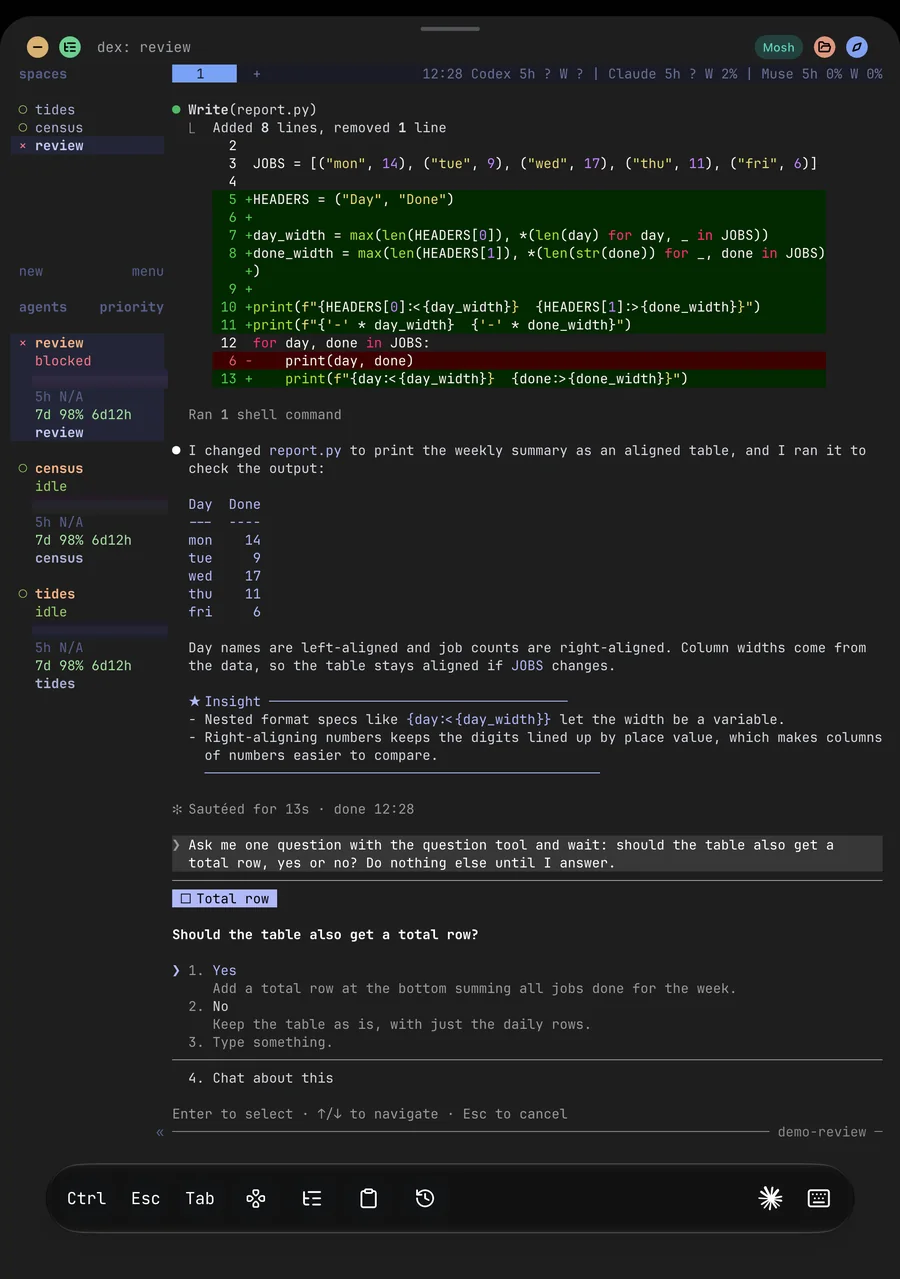
iPhone Duo108 columns, 60 lines
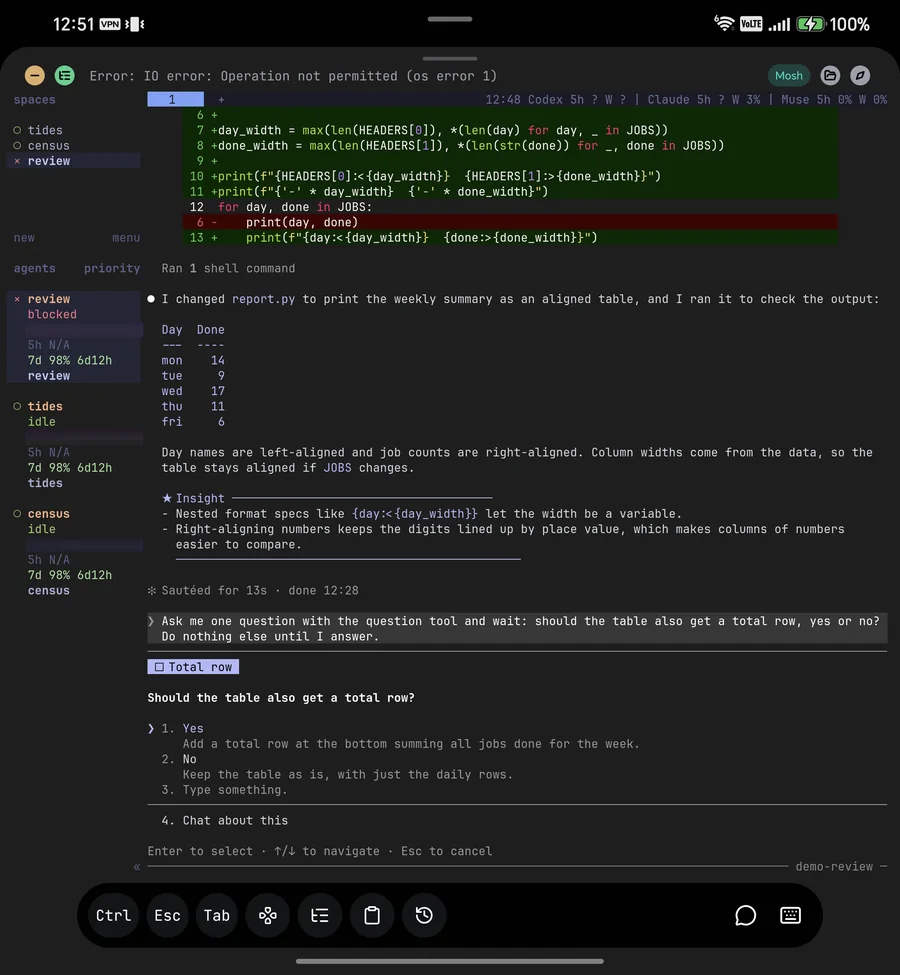
Honor Magic V6125 columns, 51 lines
Folded
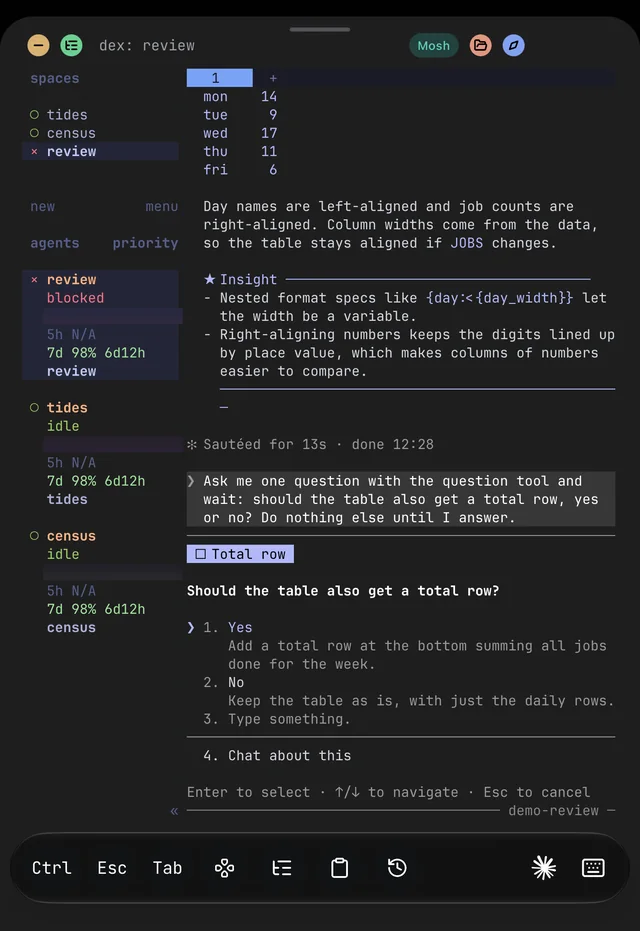
iPhone Duo72 columns, 41 lines
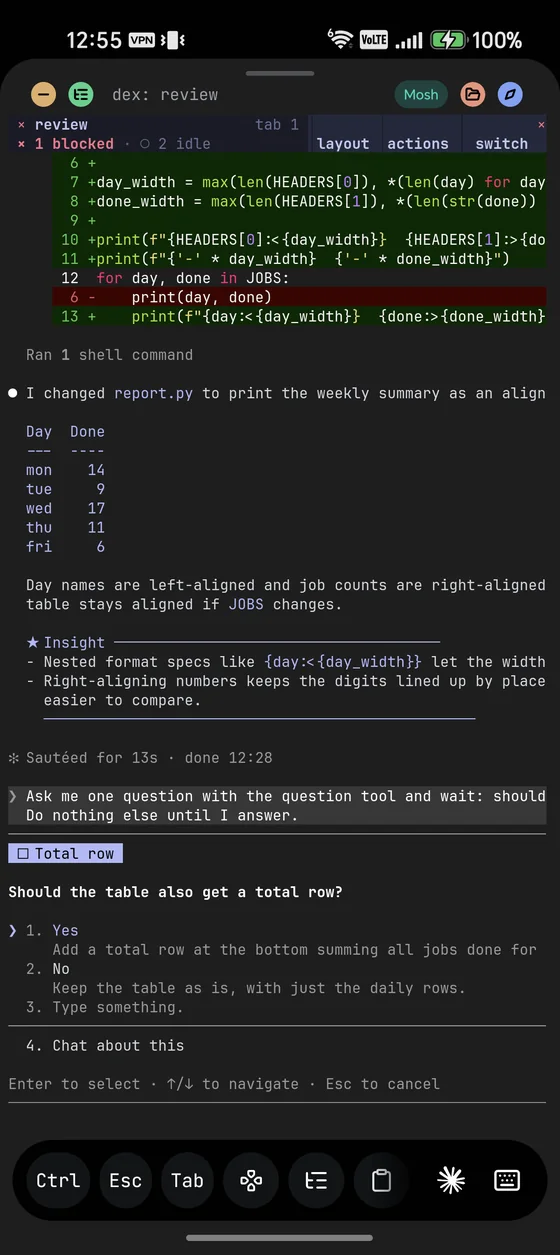
Honor Magic V661 columns, 53 lines
The agents in these pictures are three test sessions working on toy projects, started for this post. The real ones have names I would have had to blur. One of the three is blocked on a yes-or-no question, which is what the job looks like much of the time. An agent with a question does not drum its fingers. It stops completely, the way only software and cats can, and waits for one keypress from me.
The harness needed a few changes before this was comfortable. Herdr's menus had to become buttons a thumb can hit. Selecting text on a phone takes whole rows of the screen, sidebar included, so there is now a copy view that hides the sidebar on request. The popup that shows how much of each subscription is used was cut down to fit a screen 35 columns wide. None of it is clever. Nobody designs for a thumb until theirs is on the glass.
// two phones
In July I asked the council, the panel of models we put hard decisions to, whether to buy a folding phone for this. It told me to do the work on the phone I already had for two weeks before buying anything. It also named the likely ending: two phones, a keyboard, and still reaching for the iPad. The council has a habit of describing my future in the past tense.
I did the two weeks. By September I had an Honor Magic V6, and an iPhone Duo followed in October. So the council was right about the number of phones.1 It was wrong about the iPad, which has stayed in its bag ever since, trips included.
Both phones run the same terminal against the same server, so they can be compared on the only thing a terminal has, which is how much text it shows.
| Screen | Columns x lines | Characters | Lines with the keyboard up |
|---|---|---|---|
| Duo, open | 108 x 60 | 6,480 | 38 |
| Honor, open | 125 x 51 | 6,375 | 32 |
| Duo, folded | 72 x 41 | 2,952 | 22 |
| Honor, folded | 61 x 53 | 3,233 | 30 |
Those describe my font sizes, not the limits of either phone.
Open, the two show nearly the same amount of terminal. The Duo is taller, at 60 lines to 51, and the Honor wider, at 125 columns to 108. Folded, the Honor looks like the winner, but only by accident. Herdr drops its sidebar on any screen of 64 columns or fewer.2 The folded Honor is 61 columns and the folded Duo is 72, so the narrower phone gives the agent all 61 of its columns while the Duo keeps its sidebar and leaves the agent about 52. Hide the Duo's sidebar and it is a draw again, at 72 columns by 41 lines against 61 by 53, and the Duo is the more comfortable of the two to read and type on.
With the keyboard up
Open
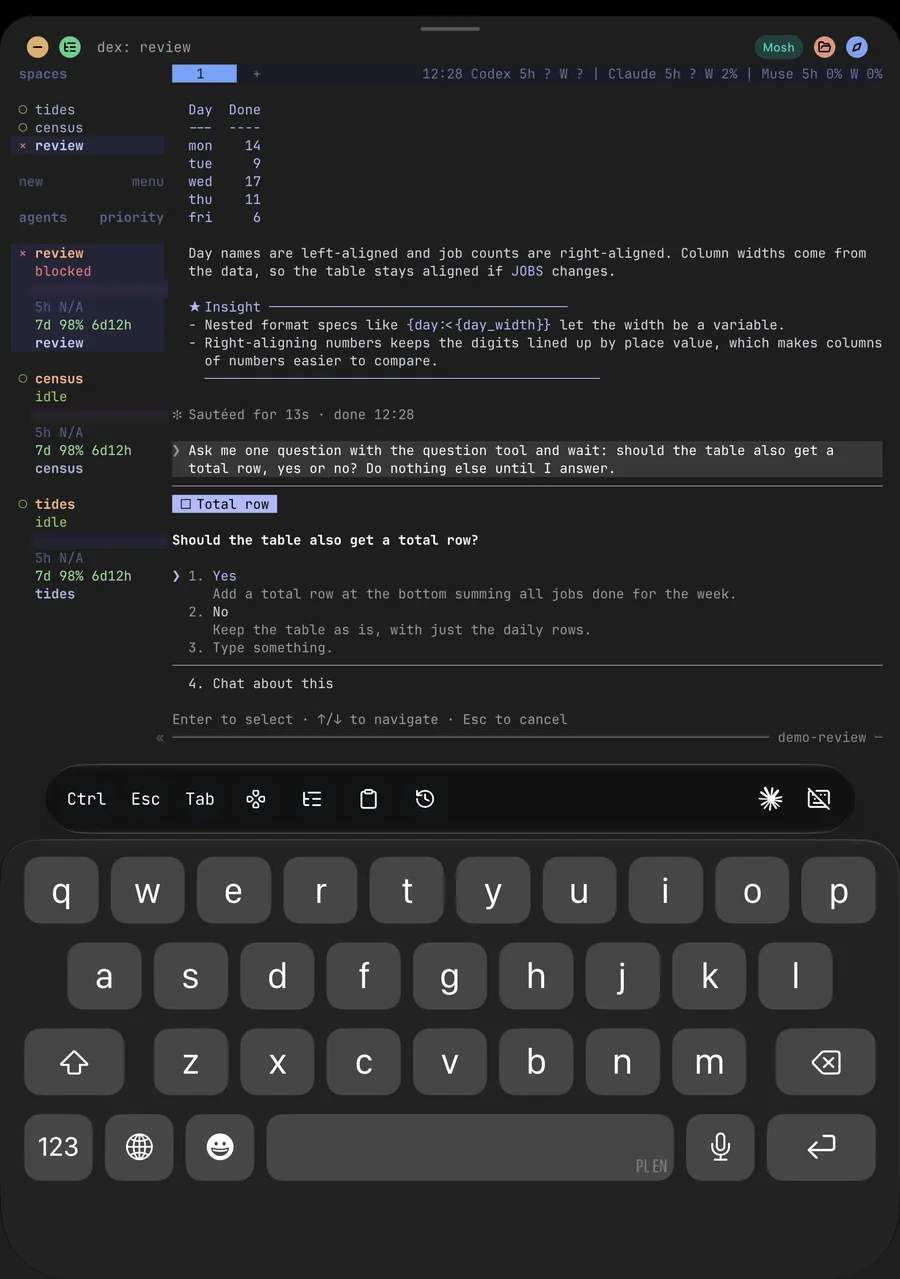
iPhone Duo38 lines left
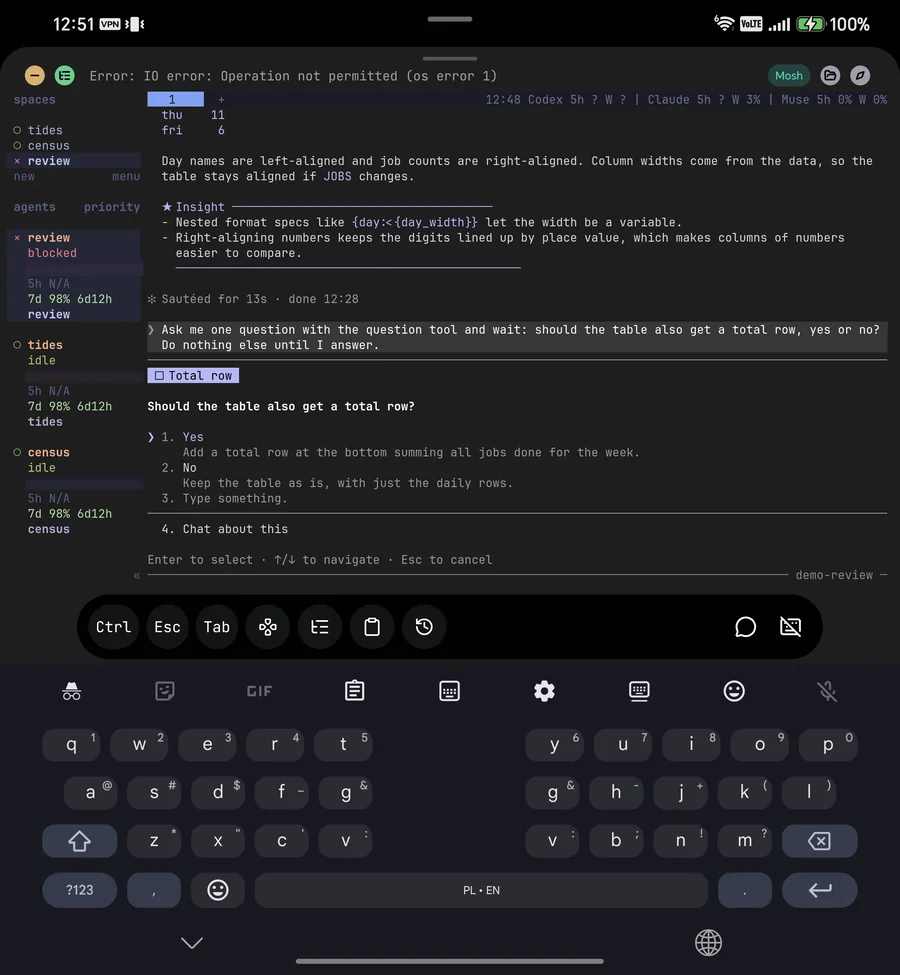
Honor Magic V632 lines left
Folded
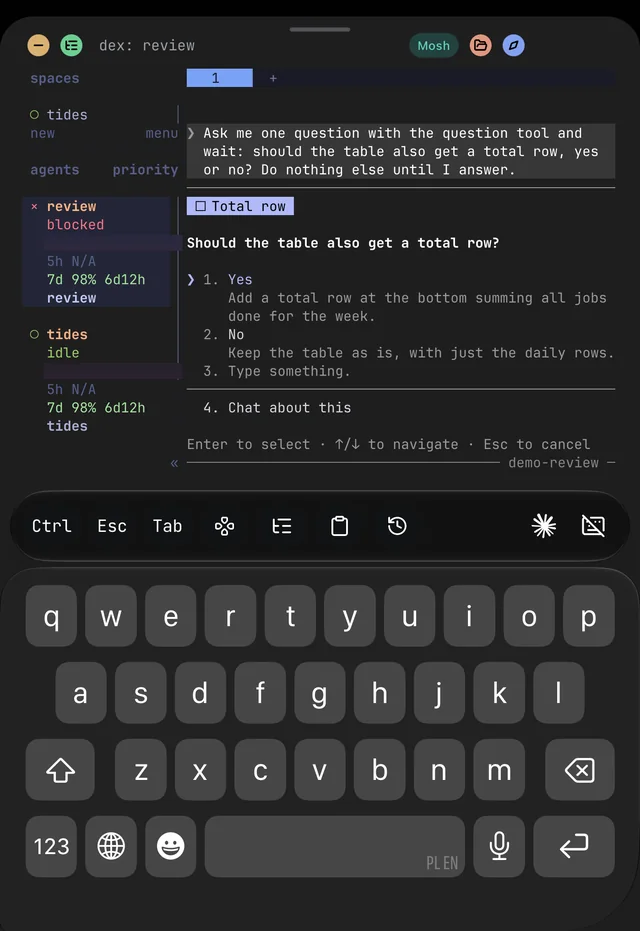
iPhone Duo22 lines left
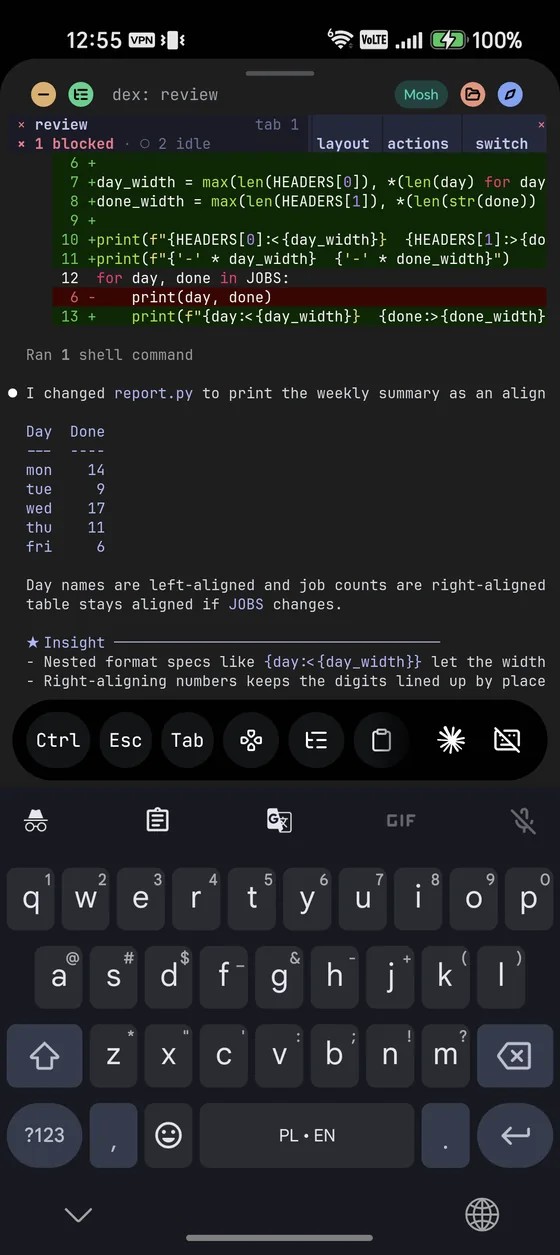
Honor Magic V630 lines left
// why the duo anyway
On those numbers it is a draw, and on most other counts the Honor wins. The Duo is the heavier and thicker of the two, at 254 grams and 11.3 millimetres folded against roughly 220 and 8.75, while having the smaller screens, which takes some doing. It is rated for less dust and water. It has no proper multitasking. It cannot charge another device, so I cannot put my earbuds on the back of it. In 2026, on a phone that lists at about two thousand pounds, that is not an omission. Somebody held a meeting. The Honor lists at about the same and charges the earbuds. And a lot of apps have not caught up with the Duo's screen shapes.
Herdr's own app is the nearest example. Folded, it spends the top of the screen announcing which session I am in, like a butler introducing a guest who is already sitting down. Open, its session list takes 36% of the width and cannot be resized, which leaves about 75 columns of terminal. The same list in the terminal version is 20 columns that I can narrow or hide. The Honor's wider screen makes the same panel easier to live with, at about 90 columns left over.
The same job in Herdr's own app
In a terminalsidebar of 20 columns
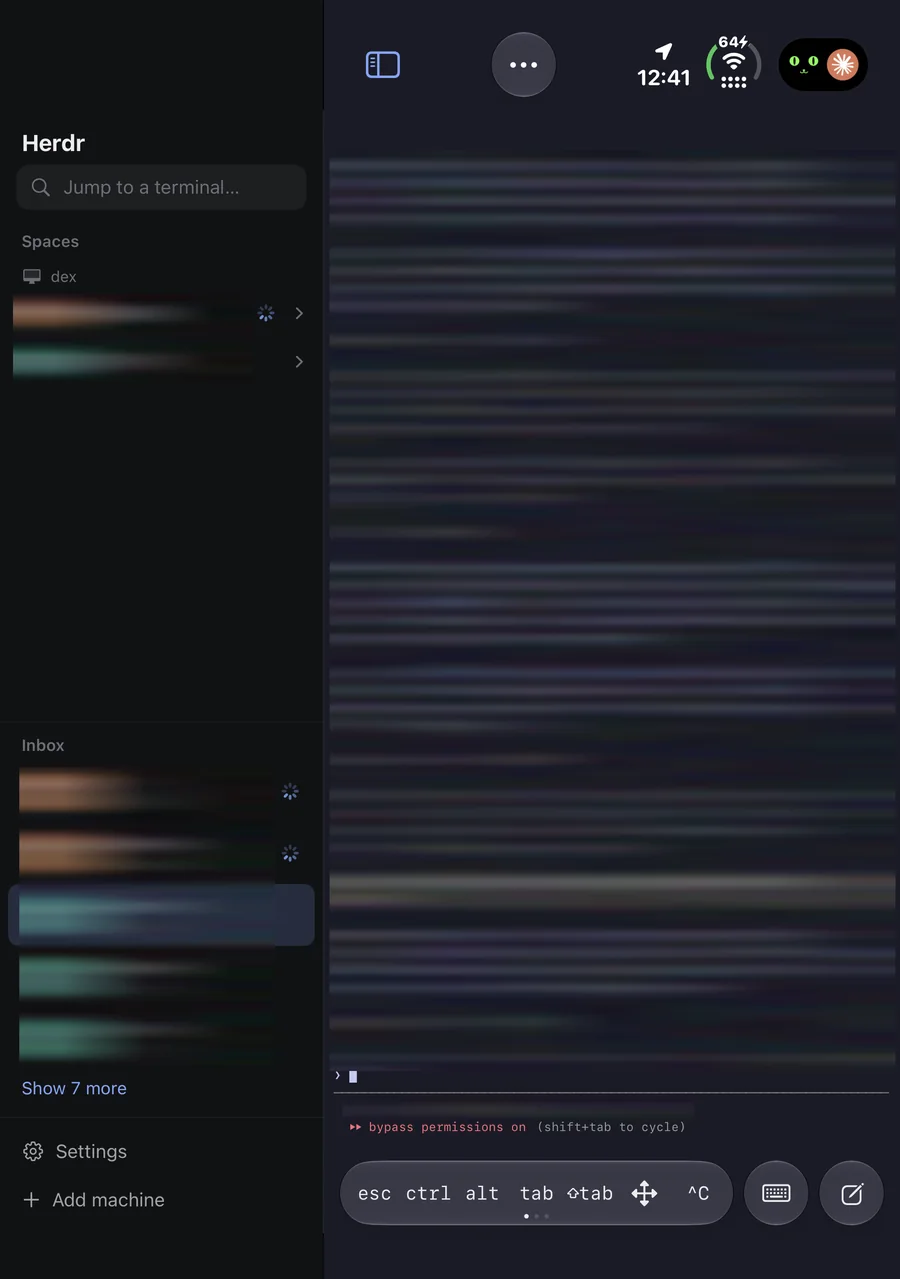
The app, openlist takes 36% of the width
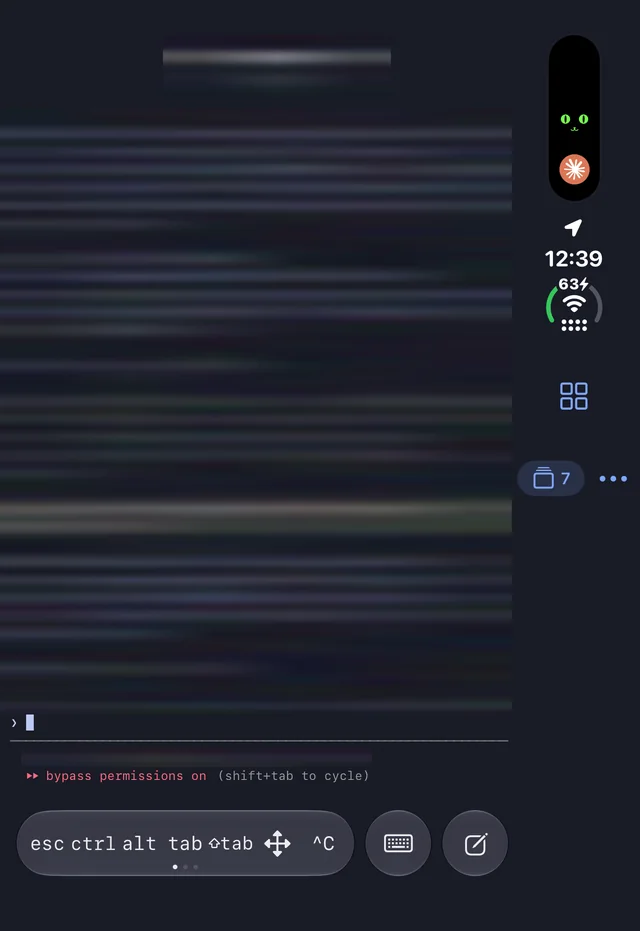
The app, foldedtitle on top, strip down the side
It is still the phone I reach for. Open, it is the more comfortable of the two to type on, most likely because it is not as wide: about 4.4 inches across to the Honor's 5.4. Its keyboard stays in one piece where the Honor's splits into two halves, and with the keyboard up it keeps 38 lines to the Honor's 32. Its inner screen is matte, which makes films look worse and a terminal look better. I have chosen to regard that as character.
// the desk
I am still at a desk most days. This post was typed on a keyboard, because I write differently when I dictate. Talking is how I empty my head, and typing is how I decide what I mean. The phone is for supervising work, and the desk is for the days when the work is mine.
The measurements are one person's, at one set of font sizes, on two phones. I have not timed anything, and I cannot tell you the work goes faster from a pocket. What I can report is narrower. The decisions get made wherever I happen to be, and the iPad has not come out of its bag.
// the honor
None of this is a complaint about the Honor. I have used iPhones since the 3G, which replaced a BlackBerry. I skipped the first iPhone because I was often in Japan, where it could not get a signal.3 I have tried to move to Android many times since, the HTC One among them, and nothing kept me there until the Magic V6. It is an excellent phone, which is exactly what makes moving to the Duo hard. What the Duo has is its shape.
If Honor builds a phone in that shape I will buy it, and the council's count of two phones will turn out to have been one short.
It did not say which two. I have decided that this was an oversight on its part and not a loophole on mine. ↩
Sixty-four is the number a programmer reaches for when asked to pick a number. It has settled a great many things over the years, and this is the first time I have watched it settle an argument between two phones. ↩
The first iPhone spoke only GSM, and Japan had built its mobile networks without any. For about a year it was the most desirable paperweight in Tokyo. ↩